
Don't just believe me. Here's proof
"Her willingness to help. She knows what she's talking about..."
"I hit the maximum limits i can deduct in a year..."
"I've never talked to someone more knowledgeable..."
"I wish I found her sooner - I'd have saves way more money..."
"I was completely unaware of these options..."
"She's one of the individuals who gained my trust..."
$1M refunded after a BIG CPA f*ck up
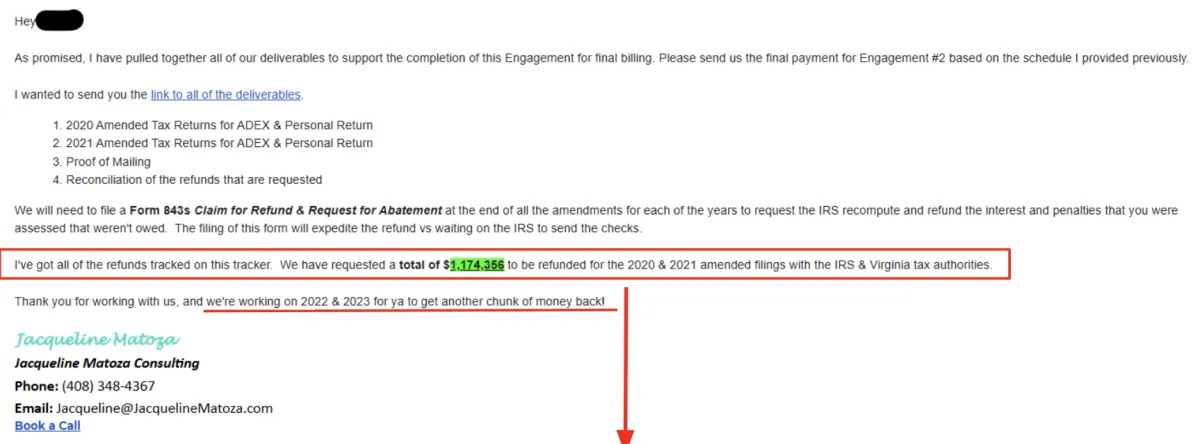

Her CPA also f*cked up
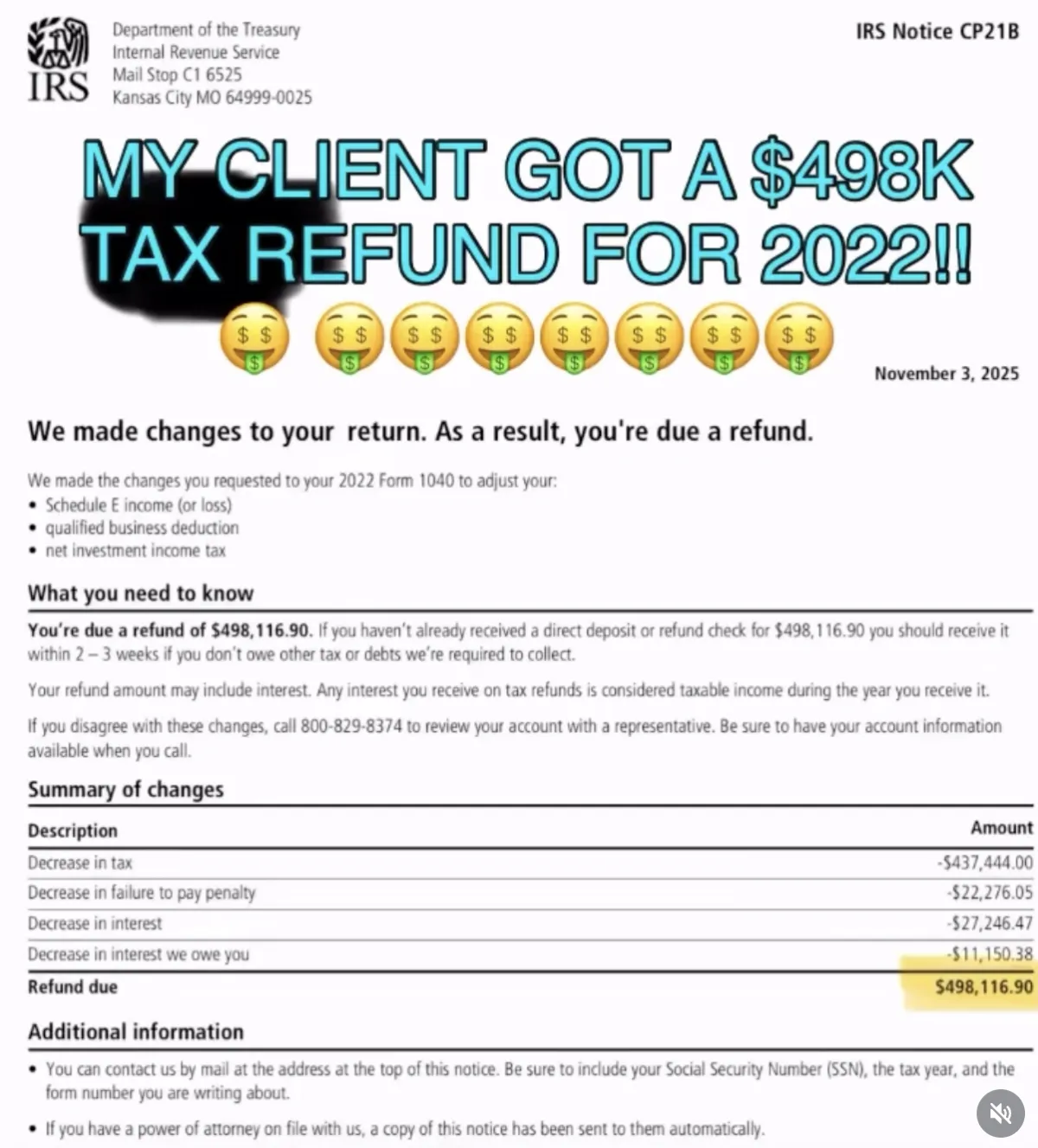
Her CPA also f*cked up

People just want a CPA who cares

Why S-Corps Are 'The Devil' for High Earners - And What to Do Instead
Most business owners end up in an S-Corp because someone told them it saves on self-employment tax.
That's not wrong, but it's only part of the picture. S-Corps only save you taxes up to a point!
For high earners (especially those clearing $250K+) the S-Corp can quietly become one of the most expensive tax structures you own.
Here's why I call it the devil:
S-Corp Jail Is Real
Nine times out of ten, business owners have never heard of S-Corp jail.
That's because most CPAs have never worked inside a real transaction, no mergers, no acquisitions, no exits/sales.
When you're in an S-Corp with multiple shareholders, every partner has to agree to any structural change. All at the same time. Or nothing changes.
I had a client with $14 million in revenue negotiating a $35 million sale. Private equity was at the table.
I couldn't restructure him because he was in an S-Corp.
The deal changed shape. The tax bill was real. That doesn't have to be your story.
The Tax Rate Gap Nobody Talks About
A C-Corporation pays a flat 21% federal tax rate.
An S-Corp flows directly into your personal return, which tops out at 37%.
That's a 43% difference in tax rates.
On a million dollars, that's not a technicality. That's your net worth.
In California specifically, the state-level spread between S-Corp and C-Corp rates is 4.5% before you even get to the federal picture.
The QBI Phase-Out Problem
Most people in S-Corps are told they can count on the 20% Qualified Business Income (QBI) deduction to offset their tax bill.
But if you run a high-margin business with a low employee count - think consulting, professional services, software - your QBI is often reduced or eliminated entirely.
I've had tax clients making $1M to $1.5M come to me after phasing out of the QBI deduction completely.
They were paying full tax rate with no QBI shelter. The S-Corp wasn't protecting them. It was exposing them.
The Deduction Ceiling
In an S-Corp, there are really only two tax deductions that clear $2.5 million.
In a C-Corp, we can generate $4.3 million in deductions on three tax planning moves alone - without aggressive tax planning.
That is the difference between zeroing out a tax bill and writing a very large check to the IRS every April.
The Depreciation Tax Trap
Anytime you move assets out of an S-Corp, the IRS treats it as a deemed sale.
That means immediate depreciation recapture. On equipment. On real estate. On machinery, computers, furniture - anything that's been depreciated inside the business.
And if your real estate has appreciated in value while you've been depreciating it? You've got even more built-in gains waiting to be triggered.
Built-in gains can happen when you've depreciated an asset. They can happen when your business grows in value. Sometimes they happen without you even knowing.
When to Make the Move
My rule: when you hit $250K as a single filer (or $500K+ married) it's time to evaluate whether you should still be in an S-Corp.
Because once your company is worth something real, the cost of staying in the wrong structure compounds quickly.
The private equity professionals I've worked with know this. They convert every business they guy into C-Corps now. Because that tax structure protects the deal.
You deserve the same advantage.
Watch the full breakdown to see exactly how this plays out - and what restructuring can look like for a business at your level.
Why S-Corps Are 'The Devil' for High Earners - And What to Do Instead
Most business owners end up in an S-Corp because someone told them it saves on self-employment tax.
That's not wrong, but it's only part of the picture. S-Corps only save you taxes up to a point!
For high earners (especially those clearing $250K+) the S-Corp can quietly become one of the most expensive tax structures you own.
Here's why I call it the devil:
S-Corp Jail Is Real
Nine times out of ten, business owners have never heard of S-Corp jail.
That's because most CPAs have never worked inside a real transaction, no mergers, no acquisitions, no exits/sales.
When you're in an S-Corp with multiple shareholders, every partner has to agree to any structural change. All at the same time. Or nothing changes.
I had a client with $14 million in revenue negotiating a $35 million sale. Private equity was at the table.
I couldn't restructure him because he was in an S-Corp.
The deal changed shape. The tax bill was real. That doesn't have to be your story.
The Tax Rate Gap Nobody Talks About
A C-Corporation pays a flat 21% federal tax rate.
An S-Corp flows directly into your personal return, which tops out at 37%.
That's a 43% difference in tax rates.
On a million dollars, that's not a technicality. That's your net worth.
In California specifically, the state-level spread between S-Corp and C-Corp rates is 4.5% before you even get to the federal picture.
The QBI Phase-Out Problem
Most people in S-Corps are told they can count on the 20% Qualified Business Income (QBI) deduction to offset their tax bill.
But if you run a high-margin business with a low employee count - think consulting, professional services, software - your QBI is often reduced or eliminated entirely.
I've had tax clients making $1M to $1.5M come to me after phasing out of the QBI deduction completely.
They were paying full tax rate with no QBI shelter. The S-Corp wasn't protecting them. It was exposing them.
The Deduction Ceiling
In an S-Corp, there are really only two tax deductions that clear $2.5 million.
In a C-Corp, we can generate $4.3 million in deductions on three tax planning moves alone - without aggressive tax planning.
That is the difference between zeroing out a tax bill and writing a very large check to the IRS every April.
The Depreciation Tax Trap
Anytime you move assets out of an S-Corp, the IRS treats it as a deemed sale.
That means immediate depreciation recapture. On equipment. On real estate. On machinery, computers, furniture - anything that's been depreciated inside the business.
And if your real estate has appreciated in value while you've been depreciating it? You've got even more built-in gains waiting to be triggered.
Built-in gains can happen when you've depreciated an asset. They can happen when your business grows in value. Sometimes they happen without you even knowing.
When to Make the Move
My rule: when you hit $250K as a single filer (or $500K+ married) it's time to evaluate whether you should still be in an S-Corp.
Because once your company is worth something real, the cost of staying in the wrong structure compounds quickly.
The private equity professionals I've worked with know this. They convert every business they guy into C-Corps now. Because that tax structure protects the deal.
You deserve the same advantage.
Watch the full breakdown to see exactly how this plays out - and what restructuring can look like for a business at your level.
All Rights Reserved © Copyright 2026 Jacqueline Matoza Consulting
Website Content, Services & Products Disclaimer: All information provided throughout our website, services or products is not and cannot ever be intended either as financial, investment, tax, legal advice or otherwise. All information is case study information about our tax planning services. Any information on our website, services or products does not and cannot ever take into account the particular financial situation, objectives or investment needs of either you or anyone reading this information. There is a very high degree of risk involved in investment. Past results are not indicative of future returns. All individuals affiliated with this site assume no responsibilities for your investment results. The indicators, strategies, columns, articles and all other features are for educational purposes only and should not be construed as investment advice. Any individual or business who chooses to act upon the content provided on this website or on information contained in any of our products or services, should always take independent specialist advice before making any decision to invest.
Earnings Disclaimer: The earnings and success stories mentioned on this site are the results of hard work, dedication, consistent applications over multiple years and strategic planning. They represent exceptional, not typical results. These outcomes are not guaranteed for every individual or business that applies our strategies. Your results may vary significantly and are dependent on many factors, including but not limited to your background, experience, work ethic, client base, and market forces beyond anyone's control. We do not purport this as a "get rich quick" scheme. Achieving success in any business requires significant effort, skill development, and consistent application of best practices. It is important to approach this program with a commitment to learn and grow, understanding that there is no guarantee of specific financial results. By choosing to engage with our content and programs, you acknowledge and agree that any business endeavor involves risk and requires considerable effort and action. We make no promises regarding your ability to earn money or achieve similar results. Your reliance on any information on this site is strictly at your own risk.
Testimonials Disclaimer: Any testimonials provided on our website, our services or products are of real-life individuals and businesses and their own personal and individual experiences. These must not be taken as "typical" results and will not be specific to your particular circumstances or actions you choose to take following receipt of the services and products.